

Barcelona
Barcelona may be a centre for some unrest and some demonstrations by the Catalan Independence Movement, but much of the crime is petty, such as pickpockets and scams - especially on the La Rambla ... but the positive things about Barcelona is the incredible architecture of Antoni Gaudí throughout the city, tapas bars, markets, a beautiful vibrant waterfront and friendly welcoming locals.
After visiting Barcelona a couple of times, we would not hesitate to return as it’s a great destination full of adventures.!!


Jim's Useful Spanish Phrases
My collection of some useful phrases to help with restaurants and getting around - using a bit of Spanish. Its always a lot easier to use a little native language, and many favourite memories come from at least trying.

Barcelona Attractions
A collection of Must See Attractions based on my research and advise from friends who have favourite restaurants and sights.


Music Palace Tour in Barcelona is a Must-See
The Palau de la Música Catalana (Palace of Catalan Music) is a concert hall in Barcelona, designed in the Catalan modernista style - with curves predominate over straight lines, and decorated with floral and organic ornaments. The highlights include a massive stained glass skylight with an inverted dome at the centre - my favourite, is the arch over the front of the stage with sculptures depicting the ‘Ride of the Valkyries’ from Wagner’s famous opera. The entire building, interior and exterior, is full of colourful mosaics, imagery, sculpture including Greek mythology.
“The concert hall is one of the most beautiful in the world without exaggeration, and is one of its most important architectural treasures.” - David Mackay

See a Flamenco Show in Barcelona.!!
Flamenco is an interesting mix of folk music influenced by Spanish, gypsy and Moorish instruments and styles.
It actually originated in Southern Spain, in Andalusia but Barcelona has become a centre of flamenco.
There are many venues to choose from, but the shows are quite a lively mix of guitar (toque), hand-clapping (palmas), foot-stomping (zapateado) and dance (baile), so it is a reallyfun night out.

Personal Tour of the Spectacular Sagrada Família
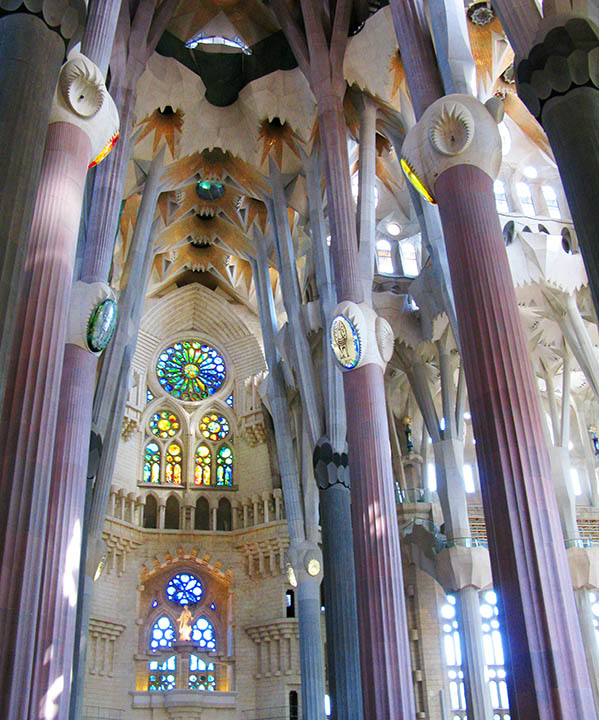
Designed by Catalan/Spanish architect Antoni Gaudí in his unusual Art Nouveau style, the Basílica de la Sagrada Família is, the yet unfinished Roman Catholic basilica in Barcelona.
Construction began in 1882, and possibly to be completed by 2026.?
But it was during a conference in Barcelona, that Geraldine met an associate who asked if we would like a private tour by a friend, who happened to be an architect working on Sagrada Família.!!! We were taken “behind the scenes” through the architect’s offices, where they had many scale models of proposed work and lots of historical drawings, models and plans. We also were able to tour up into the choir lofts and behind the alter - areas never seen by the public. (We saw the Pope’s personal elevator, although we did not get a chance to take it for a ride.!!)
What an opportunity to see this magnificent example of Gaudí’s work up close and personal.


Antoni Gaudí - the Most Famous Catalan Architect
You will find that many of the main tourist attractions in Barcelona are spectacular Gaudí creations.
His Catalan Modernista style was very individual (and somewhat controversial) in its time - but he has become known as a genius of modern architecture. His masterpieces include the magical Park Güell, Casa Batlló (also known as Casa dels ossos or House of Bones - note: Standing on the street, look up to see the arched “scaled” roof that looks like the back of a dragon.!!) but it is the rooftop of La Pedrera (Casa Mila) that makes it worth the admission, to tour around the rolling paths and chimneys that look like something from Star Wars.!!
But the fabulous church of the Sagrada Familia is the No.1 most visited attraction in Barcelona for his best examples of his ceramics, stained glass and wrought ironwork. (See above)


Beware When on this Barcelona Walking Street
The main pedestrian street, Las Ramblas is INFAMOUS for scams and pickpockets in particular.
The most fascinating to watch from a distance, was a version of the old “pea game”, where you bet which one of three shells contain a pea (known as the trilero game.) You see there is a bunch of people here, who are all part of the same gang. One switches the cups, one plays the game, three to five act as onlookers, and one is on the lookout for police. They will make it seem easy to win by allowing an accomplice to win consistently. (Even using their own 50€ note to show how “honest” they are) When you play, the dealer uses a sleight of hand trick to take the ball out at the last moment. He then puts it back under whichever cup you did not choose when opening it. It is set up so that YOU CANNOT WIN.!!
(NOTE: Beware, even as a spectator, accomplices prowl through the crowd to pick tourist pockets - as I understand it, pick pocketing is treated as a VERY minor offence, so it is allowed to thrive in Barcelona)

Confused Christopher Columbus Monument.??
Built in 1888 for the Universal Exposition, Barcelona’s Columbus Monument, the 60m (200ft) talliron column is topped by a bronze statue of the famous Italian explorer who is portrayed with nautical charts and pointing out to sea. (An elevator to the small viewing platform gives panoramic views of La Rambla, Port Vell & Montjuïc)
NOTICE - Although the monument is a tribute to the man who “discovered” the Americas - Columbus is actually facing the opposite direction - pretty odd tribute for someone renowned for his navigational skills.!!!
(Again, remember to be careful of pickpockets on the Las Ramblas)

A "Magic" Fountain in Barcelona.??
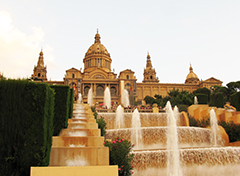
I have to say that we did not plan to go out of our way to see the “Magic Fountain of Montjuïc”. (I figured it would be a cheap imitation of the Bellagio fountain in Las Vegas at best).
Located near the Palau Nacional and the Plaça d’Espanya - it was on the way and easy to find. I have to say the light show and fountain, with performances including classical, and modern music was really spectacular - especially when you think it was first constructed for the 1929 Barcelona International Exposition. (Over 3000 workers were commissioned to work on the project for almost a year). Well worth the time to see.!!

Best Way to Get to Park Güell
Save yourself a lot of uphill walking, by taking the Bus Boss #24.
Riding the bus to Park Güell on the 24 bus starting in Plaza Catalunya. It does a bit of a city tour through some of the best architecture on Passeig de Gracia. And, winds its way up a few hillsides to the TOP of the park. Have a leisurely walk downhill in the park finishing at the main entrance. Get off at the Ctra. de Carmel – Park Güell stop and you’ll be at a more relaxed back entrance of the park. Buy your tickets there if you haven’t already.
(An alternative is to take the Metro, green line (L3), to Lesseps stop, from there it is a 20-minute walk to the entrance on Avinguda del Santuari de Sant Josep de la Muntanya, which has an escalator.)
(In the early 1900s, the park was originally planned to be a suburban housing site, with large country homes. But, after not succeeding as a commercial project it became a public park in 1926.)








© Copyright 2019. travelwithjamesdean.ca - All rights reserved. James Dean, Toronto, Canada